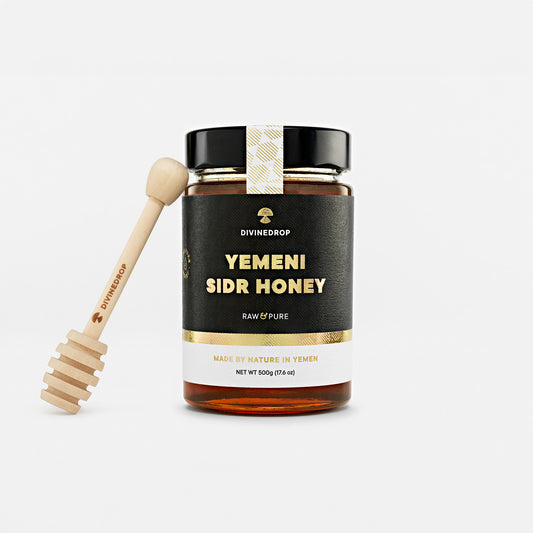
Yemeni Sidr Honey Nutrition: What It Contains and What Research Has Found
· UpdatedWhat is actually in a spoonful of Yemeni Sidr honey? More than sugar. This page sets out its composition as published research reports it, what those compounds are, and what our own laboratory tests measure, each labelled by source.

Sidr honey nutrition at a glance
Figures from published research on Yemeni Sidr honey (ranges, because every season differs):
| Component | Typical range |
|---|---|
| Fructose | about 28–42% |
| Glucose | about 22–34% |
| Sucrose | under 5% |
| Moisture | about 13–18% (Codex limit: 20%) |
| pH | 3.5–4.2 |
| Diastase number | 25–35 Gothe units |
| Total phenolics | 150–250 mg GAE per 100 g |
Honey provides about 304 kcal per 100 g (USDA figures for honey), so a tablespoon of about 21 g carries roughly 64 kcal.
The sugars: why Sidr crystallises slowly
Sidr is rich in fructose relative to glucose, with a ratio above 1.33. Fructose stays liquid; glucose crystallises. That is why Sidr crystallises slowly, over months, starting at the bottom of the jar.
The enzymes
Raw Sidr contains diastase, invertase, catalase and glucose oxidase, enzymes added by the bees. A diastase number of 25 to 35 indicates strong enzymatic activity. Heat destroys enzymes, which is why we never heat our honey and why you should keep it below 40°C.
Phenolics and flavonoids
This is where Sidr stands out. Published studies report 150 to 250 mg of phenolic compounds per 100 g, two to three times higher than many European honeys. They include:
- Flavonoids: chrysin, quercetin, kaempferol, rutin.
- Phenolic acids: gallic, caffeic, ellagic and ferulic acid.
In laboratory antioxidant tests (DPPH), Yemeni Sidr has shown 65–85% free-radical scavenging at 10 mg/ml.
What research has studied
- Authenticity: studies co-authored by Prof. Khanbash of Hadramout University distinguished genuine Sidr from other honeys with 100% accuracy using chemical fingerprints.
- Antibacterial activity: a University of Ottawa laboratory study tested Sidr against MRSA and MSSA bacteria.
- Anti-inflammatory activity: reported in laboratory and animal studies, along with protective effects on the liver and kidneys in animals.
These are laboratory and animal results. They tell researchers where to look; they are not proof of an effect in people. Our Sidr honey benefits guide covers Yemeni tradition.
What DivineDrop tests

We commission two tests on every Sidr season, at ALS Food & Environmental in New Zealand:
- Total Activity (TA): a laboratory measure of a honey's antibacterial activity. Our 2026 results: Premium Sidr TA 26.8 (ref. 26-01485-3), Royal Sidr TA 33.4 (ref. 26-01485-2). Our 2023 batch tested TA 32.4 at Analytica.
- C4 sugar test: detects cane or corn syrup. Both 2026 batches: C4 sugar result 1.0.
What TA means
TA is reported on the same activity scale used for Manuka honey. A higher TA means stronger antibacterial activity in the laboratory. We publish the result for the batch you buy, not a past peak. Compare with Manuka in Sidr vs Manuka.
How heat changes Sidr honey
Heating honey above about 40°C starts to break down its enzymes and can darken it. Add Sidr to drinks once they are warm, not hot, and never microwave the jar.
Frequently asked questions
Is Sidr honey healthier than regular honey?
It is richer in phenolic compounds than many honeys, according to published research. It is still a sugar-rich food.
How many calories are in Sidr honey?
About 60–65 kcal per tablespoon, like other honeys.
Does Sidr honey contain vitamins and minerals?
Small amounts, as all honeys do. Its standout compounds are its phenolics and enzymes.
The studies behind this page, and what each one does and does not show, are listed on our research page.
Sources
- USDA FoodData Central, nutrient data for honey
- Authentication of monofloral Yemeni Sidr honey using UV spectroscopy and chemometric analysis (PubMed)
- Alandejani et al., 2009: Effectiveness of honey on Staphylococcus aureus and Pseudomonas aeruginosa biofilms (University of Ottawa; Sidr and Manuka)
- Sidr honey: A comprehensive review of its nutritional value, biological impact, and potential health benefits (ScienceDirect, 2026)
- ALS Food & Environmental, the laboratory that tests our Sidr