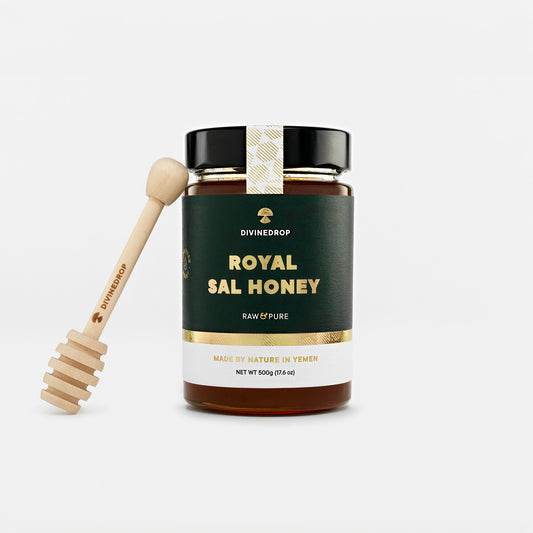
Sal Honey Benefits: Yemen's Tradition for the Throat, the Chest and Smokers
· UpdatedIn Yemen, Sal honey is the honey of winter. When the cold comes, when a cough will not settle, or when a smoker's chest feels heavy, Sal is what families reach for. This page sets out that tradition as it is lived in Yemen, what our customers tell us, and, honestly, what science has and has not yet tested.


Sal honey benefits at a glance
- A traditional winter honey for the throat and chest. Taken by the spoon when coughs, colds and phlegm (بلغم) arrive.
- The honey Yemen gives to smokers. Its warming heat is why generations of Yemeni smokers take it.
- Energy and appetite. Traditionally given to people who feel run-down or want to gain weight.
- Dense in minerals. Sal is noted for more iron, potassium, calcium and magnesium than lighter honeys.
These are traditional uses and customer experiences, not medical treatment. See a doctor for any health condition.
Where the tradition comes from
Sal honey is made from the nectar of Euphorbia ammak, a mountain plant of Taiz. Its natural compounds give the honey a heat that builds in the throat and chest after you swallow. For centuries Yemenis have connected that warmth with the chest: a honey that feels as if it is working where you need it. Of all Yemeni honeys, Sal is the one known as the specialist for the throat, the chest and the airways.
Sal honey and smokers: what Yemenis say
Across Yemen, Sal is described as the honey for smokers. Yemeni smokers traditionally take a daily spoonful of Sal for the heaviness smoking leaves in the chest. We have heard the same from customers in Australia, many of them from Yemeni and Gulf families who grew up with it.
No study has yet measured Sal honey's effect on smokers. We think it should be studied, and we would rather put the tradition on record than let it disappear unwritten.
How Sal honey is taken for the throat and chest
Straight from the spoon
The Yemeni way: one spoonful on an empty stomach, not diluted, so the warmth stays strong.
In warm tea, for a softer heat
If the burn is too much, stir it into warm tea or milk below 40°C, or mix it with Sidr honey. Many customers take Sal and Sidr together through winter.
How much, and when
Yemeni families take Sal through the cold months rather than all year: one spoonful a day, on an empty stomach, usually in the morning. In some families a second spoonful is taken at night during winter. The heat is strongest when it is taken straight.
Sal and Sidr: a winter pairing
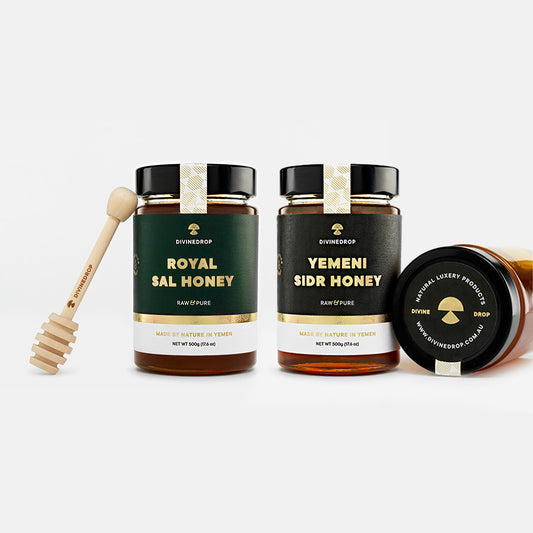
Many of our customers buy Sal and Sidr together. Sal brings the warmth; Sidr softens it and adds sweetness. Taking a spoon of each, or mixing them half-and-half, is how many families make Sal easier to take every day. See the Sidr & Sal Set.
What our customers tell us
Customers regularly write that Sal honey is the one they keep for winter, that the heat surprised them the first time, and that it soothes their throat. One review on our product page reads: "This honey is spicy with good health benefits, you can feel the effect of the honey from the first spoon mashallah." These are personal experiences, shared with permission, and not a promise of any result.
What research has found so far
The science on Sal honey is young. What is known: the heat comes from compounds in the Euphorbia nectar, including flavonoids and tamarixin, and Sal is richer in minerals than lighter honeys. What is missing: clinical studies on people. Sal has never been tested for Total Activity (TA), the laboratory measure we already publish for our Sidr honey.
That is a gap we would like to see closed. If no one records what Yemen has known for generations, no researcher will ever have a reason to test it.
Why we write this down
Sal honey has almost no literature in English. Most of what is known lives in Yemeni families and in the Gulf, passed on by word of mouth. If no one records the tradition, no researcher will ever have a reason to test it. We would rather be the ones who put it on record, clearly labelled as tradition, and invite the research, than let it stay unwritten.
Who should take care
- Pregnant women: Yemeni tradition treats Sal as a "hot" honey and does not give it during pregnancy.
- Children: many find the heat too intense. No honey is suitable for infants under 12 months.
- Anyone with a medical condition or on medication: talk to your doctor. Honey is a food, not a medicine.
Frequently asked questions
Is Sal honey good for smokers?
It is the honey Yemenis traditionally give to smokers, taken daily by the spoon. It has not been clinically studied for this.
Does Sal honey help a cough?
In Yemen it is a first choice when coughs and colds arrive, and many customers keep it for winter. It is a traditional food use, not a treatment.
Why does Sal honey burn my throat?
The warmth comes from natural compounds in the Euphorbia nectar. It is normal, and it is the reason the tradition exists. Read the complete Sal honey guide.
The studies behind this page, and what each one does and does not show, are listed on our research page.
More about where this honey comes from: the Taiz mountains.
Sources
- No published research on this honey yet; facts from DIVINEDROP's sourcing records and Product Science